How Long Does a Fridge Stay Cold in an Outage?
An unopened fridge keeps food safe for about 4 hours in a power outage, a full freezer about 48 hours. What to keep, throw away and refreeze.
Solar Wise Editorial Team
Published:
- Refrigerator (door closed): about 4 hours
- Full freezer (door closed): about 48 hours
- Half-full freezer (door closed): about 24 hours
- Meat, poultry, fish, eggs and leftovers held above 40 °F (4 °C) for more than 2 hours should be thrown away
- Most frozen food that still has ice crystals or is at 40 °F (4 °C) or below can be refrozen (except ice cream)
Short answer: When the power goes out, a refrigerator that stays unopened keeps food safely cold for about 4 hours. A full freezer holds its temperature for about 48 hours, and a half-full freezer for about 24 hours, as long as the door stays closed. These figures come from the U.S. Department of Agriculture's Food Safety and Inspection Service (USDA FSIS) and the U.S. Food and Drug Administration (FDA).
If the outage drags on, the real question is which food to keep and which to throw away once the power is back. This guide explains what to do during the outage, which foods to discard and whether frozen food can be refrozen, based on official sources.
How Long Does a Fridge Stay Cold During a Power Outage?
As long as the door stays closed, a refrigerator holds a safe temperature for about 4 hours, a full freezer for about 48 hours and a half-full freezer for about 24 hours. A safe temperature means 40 °F (4 °C) or below in the refrigerator and 0 °F (-18 °C) or below in the freezer.
These times depend on the door staying closed. Keep the refrigerator and freezer doors closed as much as possible during the outage.
What Should You Do During the Outage?
From the first minute of the outage, the most effective step is to keep the cold inside. The steps below are based on USDA and FDA guidance.
- Keep the doors closed. Open the refrigerator and freezer only when you really need to.
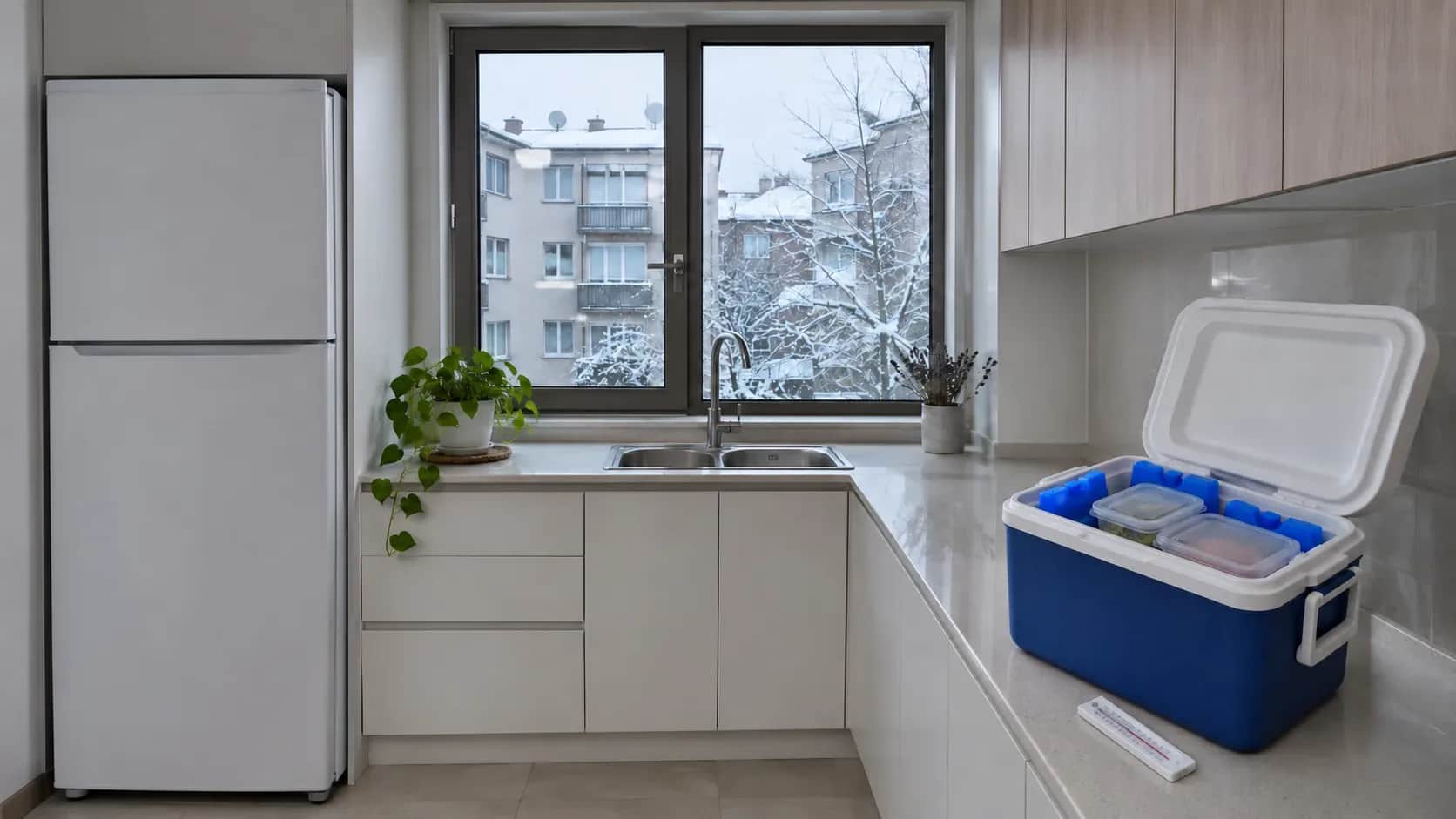
- Watch the temperature with a thermometer. An appliance thermometer in the refrigerator and in the freezer shows the temperature inside, no matter how long the power has been out.
- Use a cooler if the outage will last more than 4 hours. Move perishable food into a cooler with ice or frozen gel packs.
- Keep freezer items together. If the freezer is not full, keep items close together; this helps the food stay cold longer.
- Get ice for long outages. If the outage is going to be long, dry ice or block ice can keep the refrigerator as cold as possible.
Is It Safe to Put Food Outside or in the Snow in Winter?
No, it is not a safe method. According to the USDA, the outside temperature can change from hour to hour and will not protect refrigerated or frozen food. Even when it is very cold, sunlight can thaw frozen food. Food left outside is also exposed to unsanitary conditions and to animals.
There is a safer way to use the cold: fill buckets, empty milk cartons or similar containers with water, let them freeze outside, then put the ice in your refrigerator, freezer or cooler.
Which Refrigerated Foods Should You Throw Away When the Power Comes Back?
The basic rule: perishable foods such as meat, poultry, fish, eggs and leftovers should be thrown away if they have been above 40 °F (4 °C) for more than 2 hours. Never taste or smell food to decide whether it is safe; appearance and odor are not reliable. Check each item separately.
According to the USDA chart, refrigerated foods held above 40 °F (4 °C) for more than 2 hours should be handled as follows:
| Food | What to do |
|---|---|
| Raw or cooked meat, poultry, fish and seafood | Throw away |
| Deli meats such as salami and hot dogs | Throw away |
| Milk, cream, yogurt | Throw away |
| Eggs and egg dishes | Throw away |
| Soft cheeses such as cream cheese, mozzarella and ricotta; shredded cheese | Throw away |
| Casseroles, stews and soups; cooked pasta, rice and potatoes | Throw away |
| Cut fresh fruit, cooked vegetables, pre-cut packaged greens | Throw away |
| Custards, puddings and cream-filled pastries | Throw away |
| Opened baby formula | Throw away |
| Opened mayonnaise | Throw away if above 50 °F (10 °C) for more than 8 hours |
| Hard cheeses such as Parmesan and cheddar | Safe to keep |
| Butter and margarine | Safe to keep |
| Uncut fresh fruit and raw vegetables | Safe to keep |
| Ketchup, mustard, pickles, olives, jam | Safe to keep |
| Bread, cakes and muffins | Safe to keep |
Throw away any food in the refrigerator or freezer that has come into contact with raw meat juices.
Can You Refreeze Food From the Freezer?
Yes, in most cases. If frozen food still contains ice crystals or is at 40 °F (4 °C) or below, you can refreeze or cook it. Ice cream and frozen yogurt, however, should be thrown away even if they still have ice crystals. Partial thawing and refreezing may reduce the texture and flavor of some foods, but the food remains safe. If you keep a thermometer in the freezer, check it first when the power comes back: if it reads 40 °F (4 °C) or below, the food can be refrozen.
| Food | Still has ice crystals or is at 40 °F (4 °C) or below | Fully thawed and held above 40 °F (4 °C) for more than 2 hours |
|---|---|---|
| Meat, poultry, ground meat, fish | Refreeze | Throw away |
| Milk, soft cheese | Refreeze (texture may change) | Throw away |
| Frozen meals, pizza | Refreeze | Throw away |
| Ice cream, frozen yogurt | Throw away | Throw away |
| Frozen vegetables | Refreeze (some loss of texture and flavor) | Throw away if above 40 °F (4 °C) for more than 6 hours |
| Frozen fruit | Refreeze | Refreeze; throw away if mold, a yeasty smell or sliminess develops |
| Bread and cakes (without custard or cream filling) | Refreeze | Refreeze |
| Hard cheeses | Refreeze | Refreeze |
How Can You Prepare Before an Outage?
There is little you can do once the power is out; a few simple steps taken in advance make the real difference.
- Keep an appliance thermometer in the refrigerator and in the freezer. The refrigerator should be at 40 °F (4 °C) or below and the freezer at 0 °F (-18 °C) or below.
- Keep a few frozen gel packs in the freezer and have one or two coolers ready.
- Find out in advance where you can buy block ice or dry ice.
- Keep food that does not need refrigeration: canned goods, shelf-stable boxed milk and drinking water. If you have a baby, keep ready-to-use formula; if you have a pet, set aside pet food.
- Keep a manual can opener that does not need electricity.
Can a Portable Power Station Help During Long Outages?
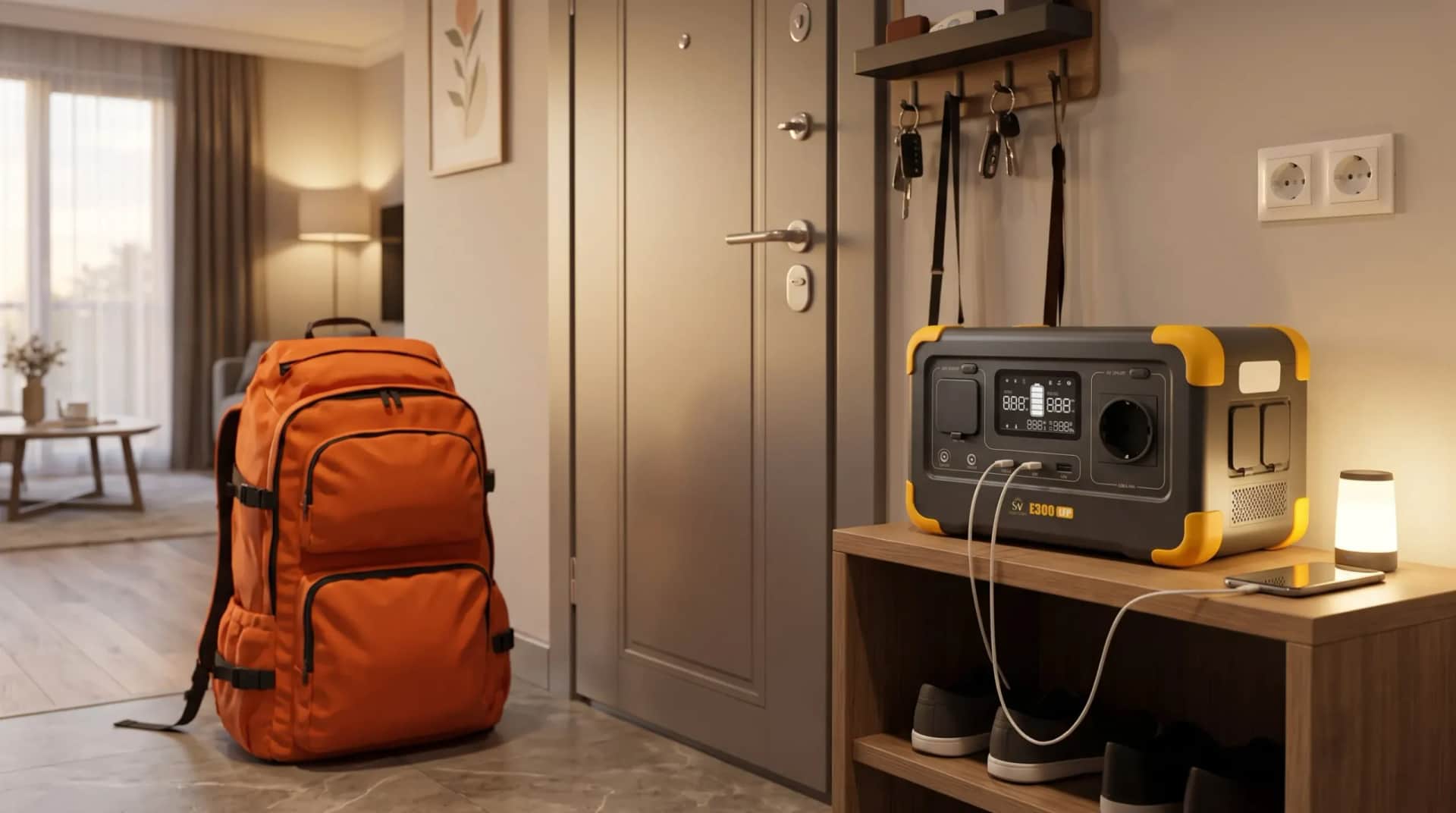
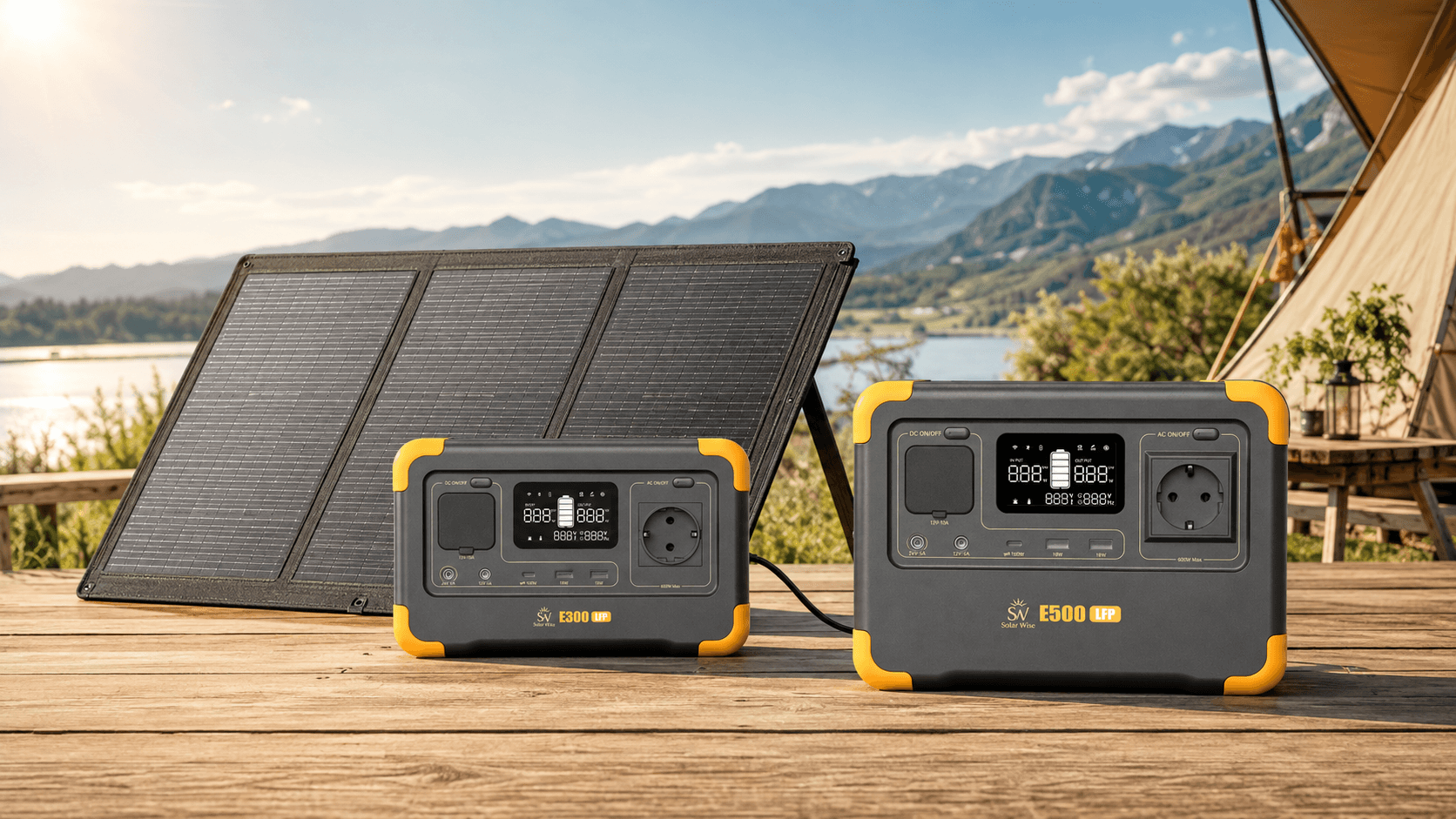
It depends on the type of refrigerator. For a full-size household refrigerator or a deep freezer, we cannot give a definitive answer. These appliances have compressors, and a compressor draws more than its normal power at the moment it starts. Because the peak (surge) power value of the Solar Wise E300LFP and E500LFP, which shows how much of this starting load they can handle, has not been published in official sources, we make no positive or negative claim about whether they can run a household refrigerator or deep freezer.
Official runtimes are published for mini fridges. According to Solar Wise product data, a small mini fridge can run for up to about 5 hours on the Solar Wise E300LFP (288 Wh) and up to about 10 hours on the Solar Wise E500LFP (576 Wh). Because the power station's peak (surge) power value has not been published, these times cannot be guaranteed for every mini fridge model; check the values on your own appliance's label.
If you use a camping or car fridge (12 V), you can connect it to the power station's car socket output. On the E300LFP and the E500LFP, this output delivers at most 12 V × 10 A = 120 W, so the power on your fridge's label should not exceed 120 W. We explain step by step how to calculate the runtime for your own fridge in how long a portable power station can run a refrigerator.
For smaller needs during an outage, such as the modem, lighting and phone charging, see what still works at home during a power outage.
Conclusion
The first rule in a power outage is to keep the doors closed: a refrigerator lasts about 4 hours, a full freezer about 48 hours and a half-full freezer about 24 hours. When the power comes back, throw away perishable food that has been above 40 °F (4 °C) for more than 2 hours; most frozen food that still has ice crystals can be refrozen. Never taste questionable food to check it.
Sources: USDA FSIS — Keeping Food Safe During an Emergency · FDA — Food and Water Safety During Power Outages and Floods

Comments
Be the first to comment
Log in to leave a comment.
Log InNo comments yet. Be the first to comment!