How Long Does It Take to Charge a Portable Power Station with a Solar Panel?
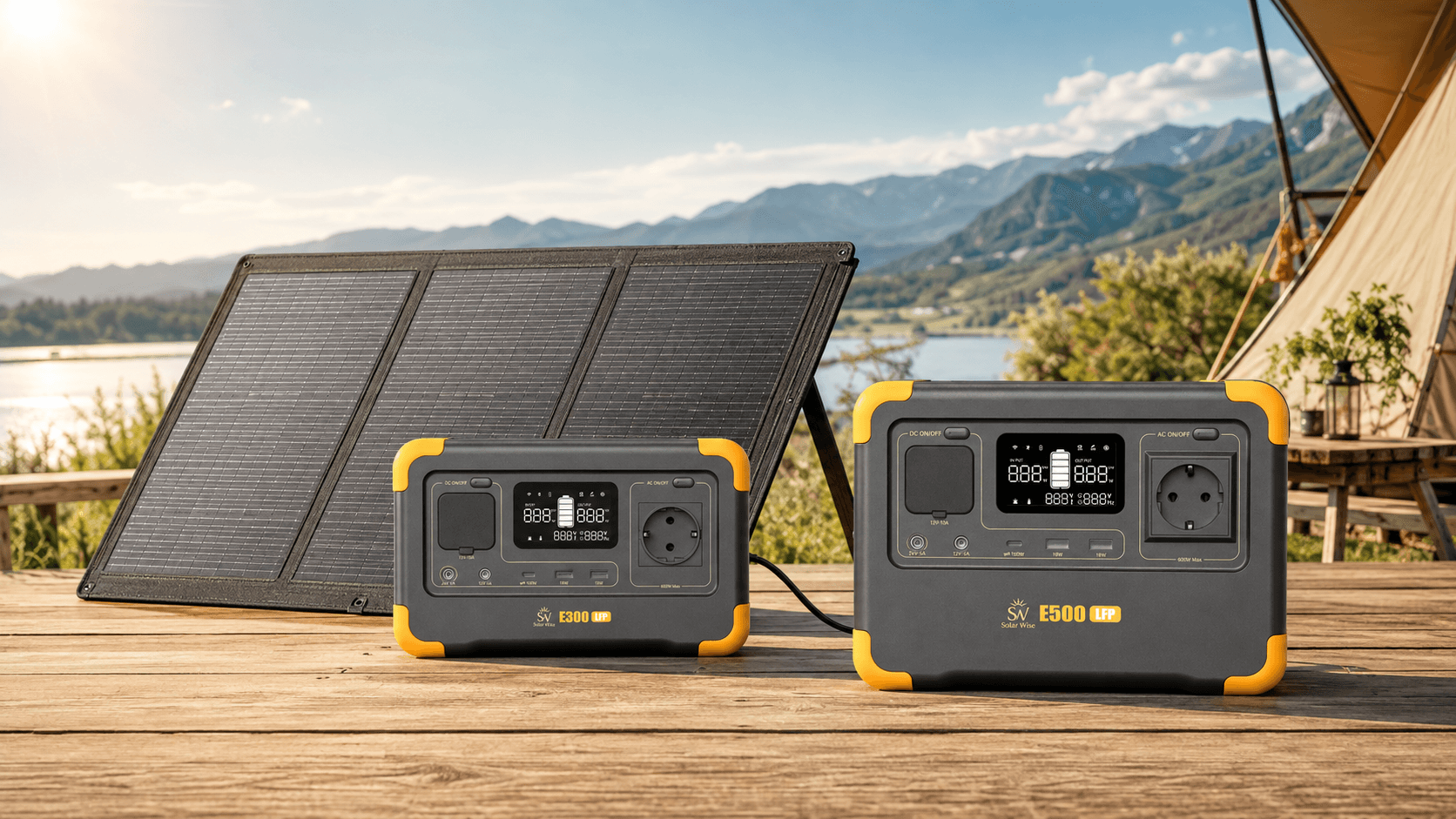
The solar charging time of a portable power station depends on its battery capacity, the panel’s actual output and weather conditions. See calculation examples for the Solar Wise E300LFP and E500LFP and learn how to choose a compatible solar panel.
Solar Wise Energy Team
Portable Energy Specialists
- At 100 W input: 288 Wh ÷ 100 W = 2.88 hours
- At 80 W input: 288 Wh ÷ 80 W = 3.6 hours
- At 60 W input: 288 Wh ÷ 60 W = 4.8 hours
- At 40 W input: 288 Wh ÷ 40 W = 7.2 hours
The time required to charge a portable power station with a solar panel depends on the battery capacity, the panel’s actual output, the angle of the sunlight, weather conditions and the power station’s maximum solar input.
Short answer: Charging time cannot be determined only by the wattage printed on the solar panel. For an accurate estimate, the battery capacity in Wh must be evaluated together with the actual wattage reaching the power station.
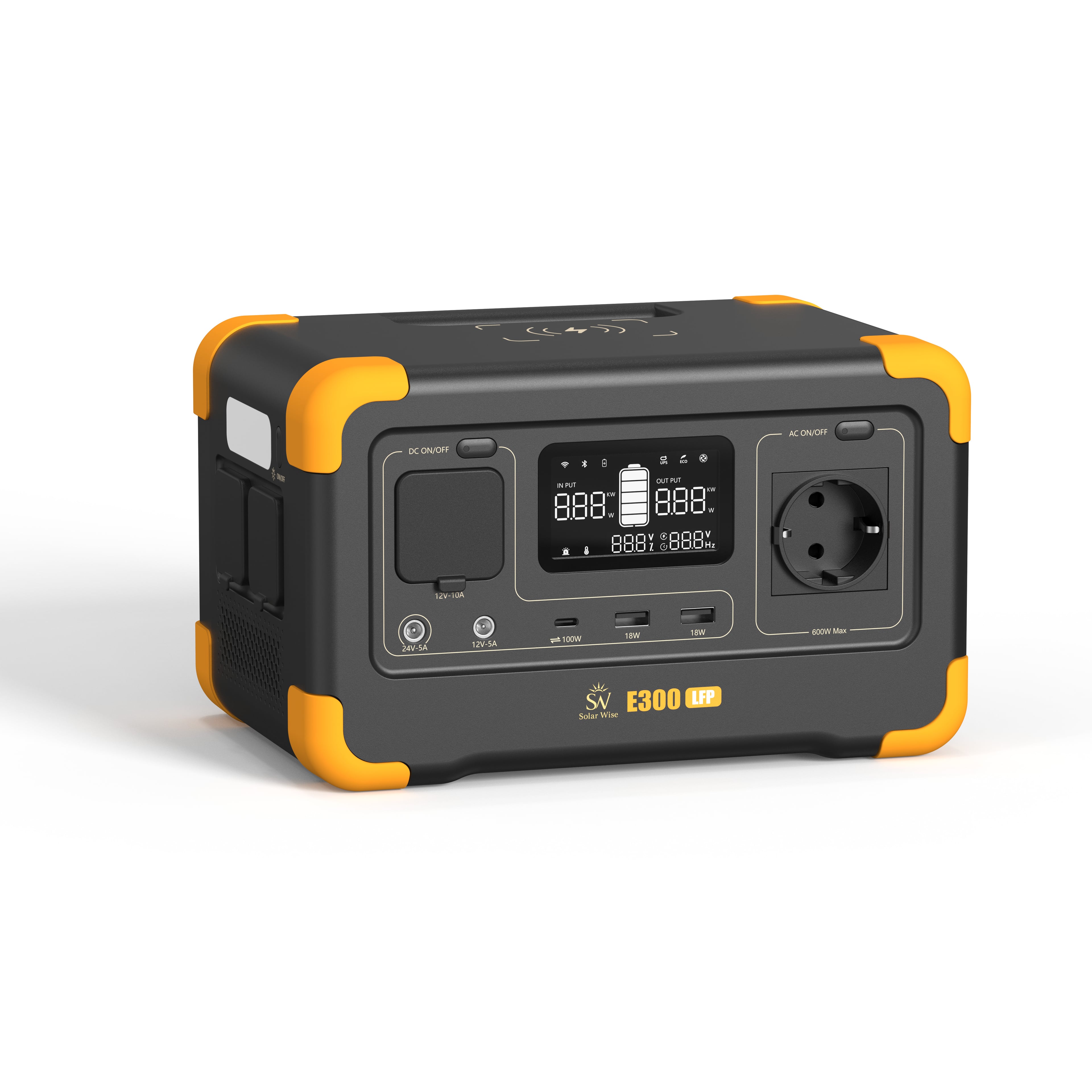
The Solar Wise E300LFP and E500LFP support a solar input range of 12–28 V DC and a maximum input power of 100 W.
How Is Solar Charging Time Calculated?
The approximate charging time can be calculated using the following formula:
Estimated charging time = Battery capacity (Wh) ÷ Actual solar input power (W)
For example, if a 288 Wh portable power station continuously receives 80 W from the solar panel:
288 Wh ÷ 80 W = 3.6 hours
This is a theoretical calculation. The actual full charging time may be longer due to conversion losses, reduced charging power near full capacity, temperature, clouds and partial shading.
E300LFP and E500LFP Solar Charging Times
| Model | Battery capacity | 100 W input | 80 W input | 60 W input | 40 W input |
|---|---|---|---|---|---|
| Solar Wise E300LFP | 288 Wh | 2.88 hours | 3.6 hours | 4.8 hours | 7.2 hours |
| Solar Wise E500LFP | 576 Wh | 5.76 hours | 7.2 hours | 9.6 hours | 14.4 hours |
The values in the table are theoretical estimates that assume the stated input power remains constant. Actual full charging times may be longer because of changing sunlight and system losses.
How Long Does the E300LFP Take to Charge with a Solar Panel?
The Solar Wise E300LFP has a 288 Wh battery capacity and supports up to 100 W of solar input.
How Long Does the E500LFP Take to Charge with a Solar Panel?
The Solar Wise E500LFP has a 576 Wh battery capacity and supports up to 100 W of solar input.
- At 100 W input: 576 Wh ÷ 100 W = 5.76 hours
- At 80 W input: 576 Wh ÷ 80 W = 7.2 hours
- At 60 W input: 576 Wh ÷ 60 W = 9.6 hours
- At 40 W input: 576 Wh ÷ 40 W = 14.4 hours
Does a 100 W Solar Panel Always Produce 100 W?
No. The 100 W rating printed on a solar panel represents its nominal maximum output under suitable test conditions. In everyday use, the panel’s actual output will vary.
The main factors affecting solar panel output include:
- The angle of the sunlight
- Cloud cover and weather conditions
- The season and time of day
- Dust or dirt on the panel surface
- Full or partial shading
- Panel and ambient temperature
- Cable and connection losses
- The power station’s maximum solar input limit
For the most accurate calculation, use the actual input wattage displayed on the power station rather than the panel’s nominal rating.
Can Any Solar Panel Be Connected to a Portable Power Station?
No. The solar panel’s voltage, connector and output specifications must be compatible with the portable power station.
The solar input specifications of the Solar Wise E300LFP and E500LFP are:
- Input voltage: 12–28 V DC
- Maximum input power: 100 W
According to the E300LFP user manual, the open-circuit voltage, or VOC, of a single panel must be below 28 V, while its operating voltage, or VMP, must be above 12 V.
An incompatible panel may prevent charging or damage the power station. Always check the technical specifications of both the solar panel and the power station before connecting them.
Is a 100 W Solar Panel Sufficient?
A compatible 100 W solar panel is a suitable choice because the E300LFP and E500LFP accept a maximum solar input of 100 W.
Connecting a panel with a higher wattage rating does not mean that the power station will automatically receive more than 100 W. Wattage alone is not enough to determine compatibility. The panel voltage must also remain within the supported 12–28 V DC input range.
Can a Portable Power Station Charge on a Cloudy Day?
Yes. A solar panel can continue generating energy in cloudy weather, but its output will normally be lower and less consistent than under direct sunlight.
For example, if the E300LFP receives an average of 40 W, its theoretical charging time is 7.2 hours. Under the same input conditions, the theoretical charging time of the E500LFP is 14.4 hours.
Because cloud cover and panel output can change throughout the day, these figures should not be treated as guaranteed full charging times.
Does the Solar Panel Angle Affect Charging Time?
Yes. Positioning the panel at an appropriate angle toward the sun directly affects the available input power.
For more efficient solar charging:
- Point the panel surface directly toward the sun.
- Keep the panel away from shadows caused by trees, buildings, tents or vehicles.
- Adjust the panel angle as the sun moves during the day.
- Fully unfold a foldable solar panel.
- Keep the panel surface clean.
- Check that all cables and connectors are securely attached.
Even partial shading can reduce total solar output and extend the charging time.
Can the Power Station Be Used While It Is Charging?
Yes. A Solar Wise portable power station can be used while it is being charged.
However, if the connected appliances consume more power than the solar panel supplies, the battery level may continue to decrease instead of increasing.
For example, if the panel provides 70 W while a connected appliance consumes 100 W, there is a power deficit of approximately 30 W. In this situation, the battery level will gradually decrease.
What Is MPPT?
MPPT is a charging technology that tracks a suitable operating point to help obtain energy from a solar panel under changing light conditions.
The voltage and current produced by a solar panel change as sunlight and panel temperature vary. An MPPT system helps the power station use the available solar energy more efficiently.
However, MPPT cannot completely eliminate the production losses caused by clouds, shadows, dirt or incorrect panel positioning.
How Can Solar Charging Time Be Reduced?
- Point the panel directly toward the sun.
- Adjust the panel angle several times during the day.
- Keep the panel away from shaded areas.
- Remove dust and dirt from the panel surface.
- Avoid unnecessarily long or low-quality extension cables.
- Make sure all connectors are securely attached.
- Turn off high-consumption appliances while charging.
- Do not leave the panel or power station in excessively hot environments.
- Monitor the actual input wattage shown on the power station’s display.
Conclusion
The time required to charge a portable power station with a solar panel is not fixed. The most useful estimate is obtained by dividing the battery capacity by the average solar input power shown on the power station’s display.
- E300LFP: 288 Wh ÷ 100 W = theoretically 2.88 hours
- E500LFP: 576 Wh ÷ 100 W = theoretically 5.76 hours
These results assume an ideal and continuous 100 W input. Under real operating conditions, the full charging time will be longer because of sunlight variations, temperature, panel positioning and system losses.
Frequently Asked Questions
How long does it take to charge a portable power station with a solar panel?
Charging time depends on the battery capacity and the panel’s actual output. The approximate time can be calculated by dividing the battery capacity in Wh by the actual solar input power in watts.
How long does a 100 W panel take to charge the E300LFP?
With a continuous 100 W input, the theoretical charging time is 2.88 hours. The actual full charging time will be longer because of conversion losses and changing sunlight.
How long does a 100 W panel take to charge the E500LFP?
With a continuous 100 W input, the theoretical charging time is 5.76 hours. Actual charging time may increase depending on weather, panel angle, temperature and system losses.
Can a solar panel be connected directly to a portable power station?
Only if its voltage, connector and output specifications are compatible with the power station. The E300LFP and E500LFP support 12–28 V DC and a maximum solar input of 100 W.
Can the power station be used while charging from a solar panel?
Yes. However, if the connected appliances consume more power than the panel supplies, the battery level may decrease while the power station is charging.
Can solar charging be used in cloudy weather?
Yes, but the panel output will be lower and the charging time will increase. Calculations should use the actual input wattage shown on the power station rather than the panel’s nominal rating.
Comments
Be the first to comment
Log in to leave a comment.
Log InNo comments yet. Be the first to comment!