
What Still Works at Home During a Power Outage?
What works and what does not when the power goes out? Clear answers for your modem, refrigerator, heater and air conditioner, plus official runtimes and a simple way to calculate your own.
Solar Wise Editorial Team
Published:
- Everything connected to the grid stops — refrigerator, boiler, modem and lighting included
- Battery-powered devices run a little longer, but you cannot recharge them
- A power station keeps plug-in devices under 600W running
- High-power and hardwired appliances will not run
- How long it lasts is set by battery capacity (Wh), not by output power
Short answer: when the power goes out, everything connected to the grid stops — only devices with their own battery (phone, laptop, rechargeable lamp) keep running for a while. Once you connect a portable power station, plug-in devices that draw under 600W continuously keep working: your modem and router, a laptop, LED lighting, phone charging and small electronics. High-power appliances such as electric heaters, air conditioners, instant water heaters and built-in ovens will not run; most of them are both above the 600W limit and hardwired into your fixed installation, so they have no plug at all. For compressor appliances such as a full-size refrigerator or a chest freezer, no definite answer is possible, because the starting surge figure is not published in any official source; check the rating label on your own appliance.
What Exactly Happens at Home During an Outage?
The moment the power cuts, every socket and lighting circuit in the house loses energy at the same time. The refrigerator stops, the boiler shuts down, the modem goes dark and the internet disappears, and an electric heater simply will not run. This does not mean anything is broken; the supply has just been interrupted.
Devices with their own battery keep going for a while: mobile phone, tablet, laptop, rechargeable torch and camping lamp. But once their charge runs out you have no way to top them up — and that is usually where the real problem of an outage begins.
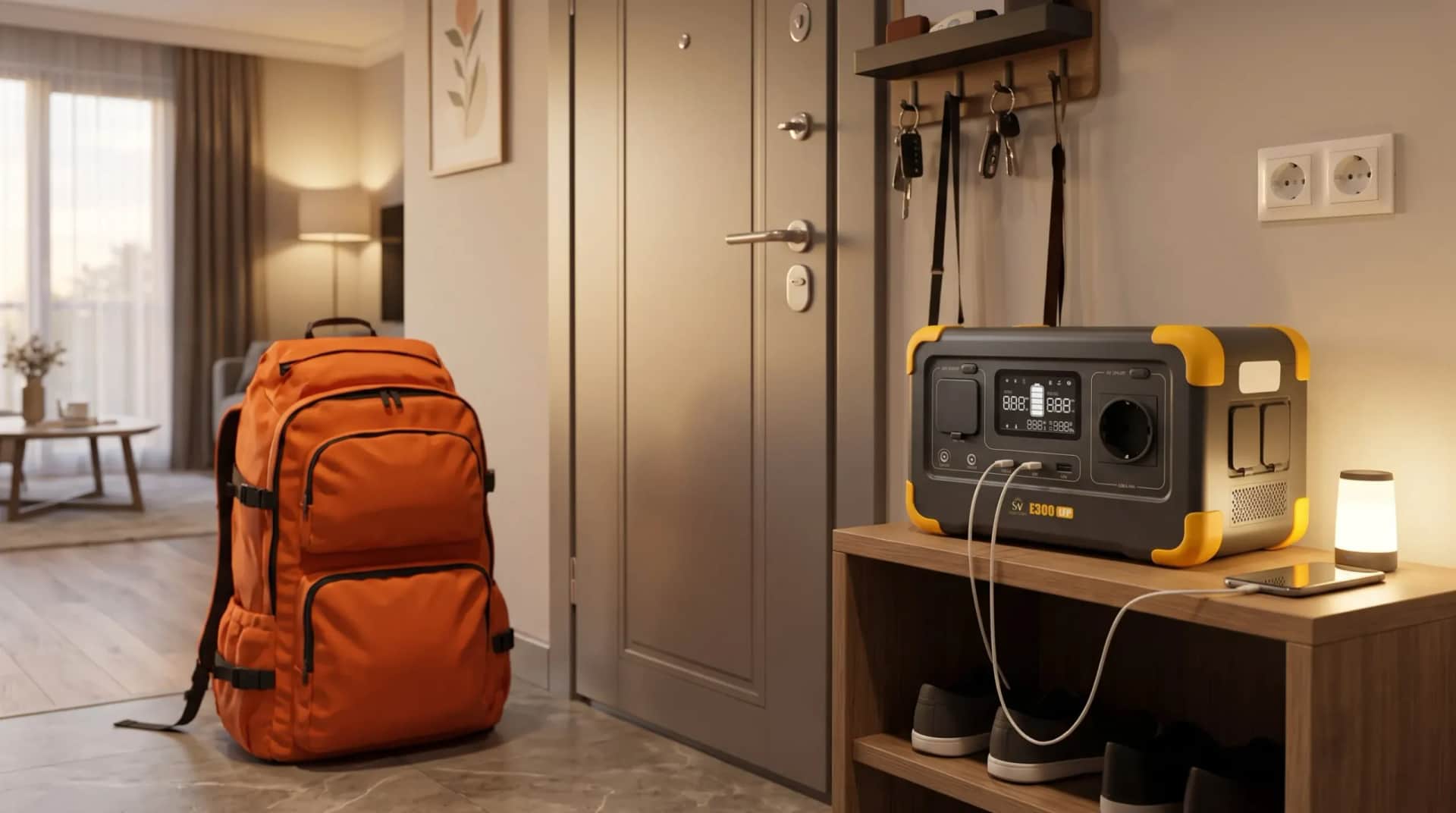
A portable power station fills exactly this gap. It is a battery you charge in advance; when the outage comes you plug your mains devices into it and they keep running until the stored energy is used up.
First, Separate Two Values: Watts and Watt-Hours
This is the most commonly confused point when planning for an outage, and it directly affects which device you should choose.
Watt (W) tells you how much power a device draws at any one moment. A power station with a 600W output can run devices that stay below 600W. Watt-hour (Wh) tells you how much energy is stored in the battery in total, and that is the value that determines duration.
In practice: of two units both rated 600W, one with 288Wh and one with 576Wh, both will run the same devices — but the second will run them roughly twice as long. You can find the difference explained in detail in our guide to watts versus watt-hours.
How Long Does Each Device Run?
The runtimes below are the official values published on the Solar Wise product pages and are given as "up to". Your device's actual consumption, the ambient temperature and how you use it will change the result.
| Device | E300LFP (288Wh) | E500LFP (576Wh) |
|---|---|---|
| Wi-Fi modem / router | up to 20 hours | up to 40 hours |
| LED work light | up to 20 hours | up to 40 hours |
| Office laptop | up to 6 hours | up to 12 hours |
| Smartphone | up to 14 charges | up to 28 charges |
| CPAP device | up to 8 hours | up to 16 hours |
| Aquarium air pump | up to 8 hours | up to 16 hours |
| Mini refrigerator (small) | up to 5 hours | up to 10 hours |
What this table means in practice: in a typical household outage, the internet, lighting and phone side is comfortably covered. Through an overnight cut your modem and a few LED lamps will run without trouble.
An honest note about televisions: a television is suitable in terms of connection type and power draw, but Solar Wise has not published an official runtime for this device. For that reason we will not give an hour figure here; check the watt rating on your television's label and work it out yourself with the formula below.
How Do You Calculate the Runtime for Your Own Device?
For any device not in the table you can calculate the runtime yourself. The official formula given in the Solar Wise E300LFP user manual is:
Runtime (hours) = Total Capacity (Wh) × 0.85 ÷ Device Power (W)
Example: for a device drawing 60W, the E300LFP (288Wh) gives roughly 4.1 hours and the E500LFP (576Wh) roughly 8.2 hours. The 0.85 factor accounts for the fact that not all of the energy in the battery reaches the socket (conversion losses).
If you do not know how many watts your device draws, check its technical label; it usually shows a W value or a V/A rating. For a step-by-step explanation see our guide on how to calculate power station runtime, and for a quick estimate you can use the Solar Wise Power Calculator.
Which Devices Will Not Run?
This is the most important section of the article, because wrong expectations are formed here more than anywhere else. The appliances below will not run on a 600W-class power station, and most of them face two separate obstacles, not just one.
The first obstacle is power: these appliances draw far more than 600W continuously. The second is the connection: most of them are hardwired into the fixed installation and have no plug, so they cannot be connected to a power station directly at all.
| Appliance | Why it will not run |
|---|---|
| Electric heater / convector | Above 600W |
| Air conditioner (indoor/outdoor unit) | Above 600W · mostly hardwired · compressor driven |
| Instant water heater / storage water heater | Above 600W · mostly hardwired |
| Built-in oven and hob | Above 600W · hardwired |
| Water pump / booster pump | Above 600W · mostly hardwired · motor driven |
| Full-size refrigerator, chest freezer | Because the starting surge figure is not published in any official source, no definite answer is possible — check the appliance label |
Important safety note: you cannot connect a power station to your home's fixed electrical installation yourself. Such an installation is only possible through work carried out by a licensed electrician using a compliant bypass/transfer switch. Interfering with the installation without authorisation is dangerous and can also void your warranty and your insurance.
Modem and Internet: the Most Noticeable Part of an Outage
The first thing most people notice in an outage is that the internet is gone — and for many it is the most irritating part. The good news is that a modem and router draw very little power, so even a small power station will run them for a long time.
The Solar Wise E300LFP and E500LFP can operate in UPS mode: when the grid fails they switch to battery in roughly 8–20 milliseconds. In most cases that is fast enough to keep the modem from restarting — so you can ride out the cut without losing your connection.
An important limit: this feature is not a certified zero-millisecond (online) UPS. It is not recommended for servers or for medical systems that require a certified 0 ms transfer. You can find the distinction explained in our article on the difference between a UPS and a portable power station. For modem-specific runtime figures, see how long a power station can run a Wi-Fi router.
What About the Refrigerator?
This is the most frequently asked question, and the honest answer is: it depends on the type of refrigerator, and no guarantee can be given for every model.
For a small mini refrigerator, official values have been published: up to 5 hours with the E300LFP and up to 10 hours with the E500LFP. A full-size, compressor-driven refrigerator is a different matter: the moment the compressor starts it draws more power than its normal consumption, and that starting surge figure has not been published in any official source. For that reason it would be wrong to say either "it will run" or "it will not run"; you need to check the values on your own appliance's label.
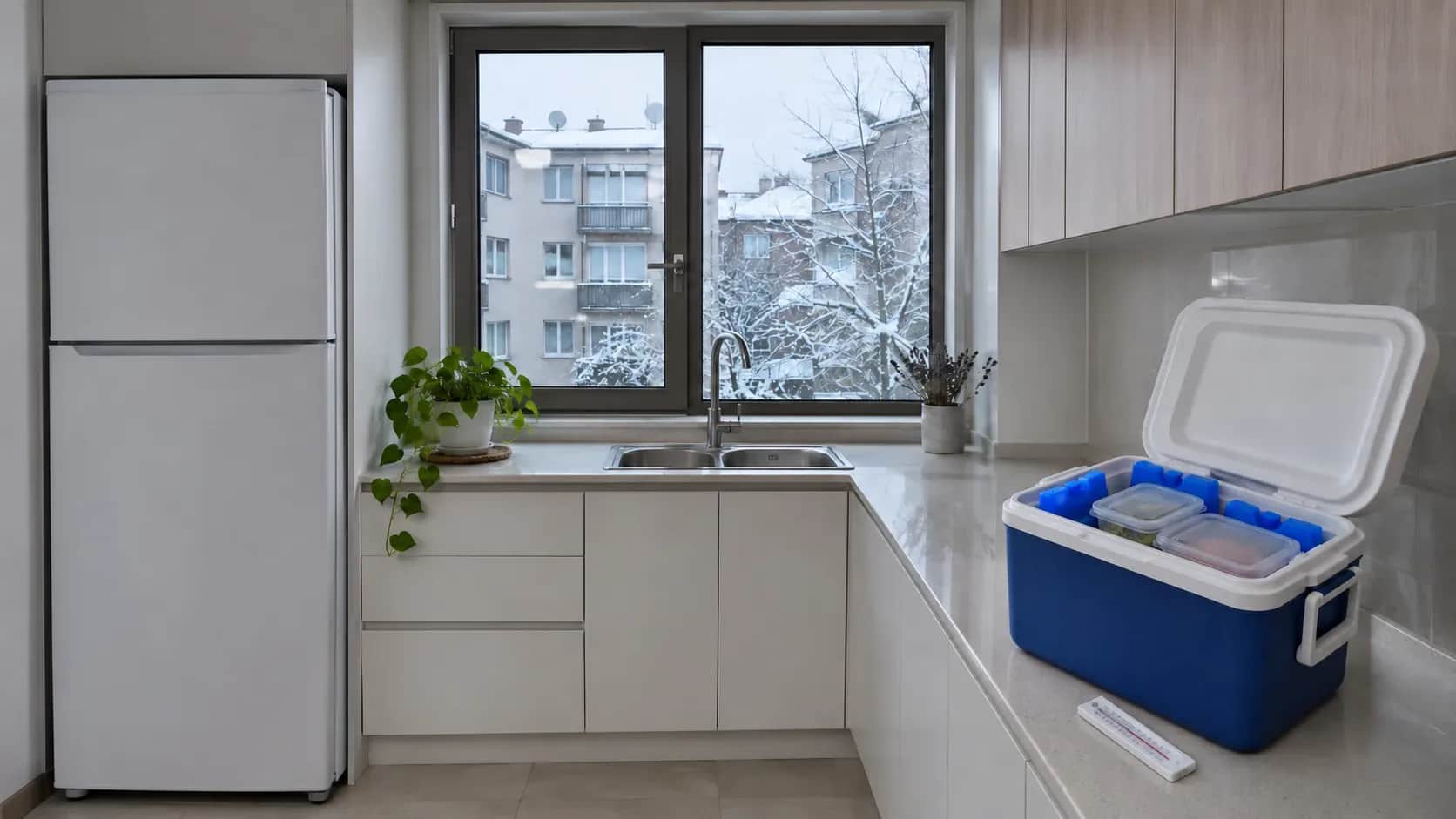
A practical note: during short outages, not opening the refrigerator door is the single most effective thing you can do. A closed refrigerator can hold its cold for several hours. For more detail see how long a power station can run a refrigerator.
What to Do Before an Outage
Preparing in advance is more effective than anything you can do during the outage itself. The steps below take a few minutes and turn a power cut into a completely different experience.
- Keep the power station charged. The E300LFP charges fully in about 80 minutes and the E500LFP in about 90 minutes; both reach 80% in roughly 60 minutes.
- Decide in advance which devices you will run. A modem, one lamp and phone charging is enough for most homes.
- Write down the wattage of those devices once. Reading labels during an outage is difficult.
- Keep the modem connected in UPS mode so the connection does not drop when the power cuts.
- Keep an LED lamp and an extension lead next to the power station.
- If outages in your area can last a long time, consider a solar panel — it lets you recharge during daylight.
Safety During an Outage
A few common mistakes during an outage create real danger. Knowing these matters more than knowing which device will run.
Never run a generator in an enclosed space. A generator produces exhaust gas containing colourless, odourless carbon monoxide. It must never be run indoors, in a garage, a basement, on a balcony, or inside a tent or caravan — no enclosed or semi-enclosed space at all. An open window does not remove this risk. For a comparison of the two devices see portable power station versus generator.
Do not touch the installation yourself. Any work on the fuse box, a socket or the wiring is a job for a licensed electrician.
Never leave candles unattended. A significant share of fires during outages start with candles; an LED lamp is both safer and lasts far longer.
Do not switch everything on at once when the power returns. Bringing high-power appliances back a few minutes apart prevents the breaker from tripping.
If the Outage Lasts: Recharging with a Solar Panel
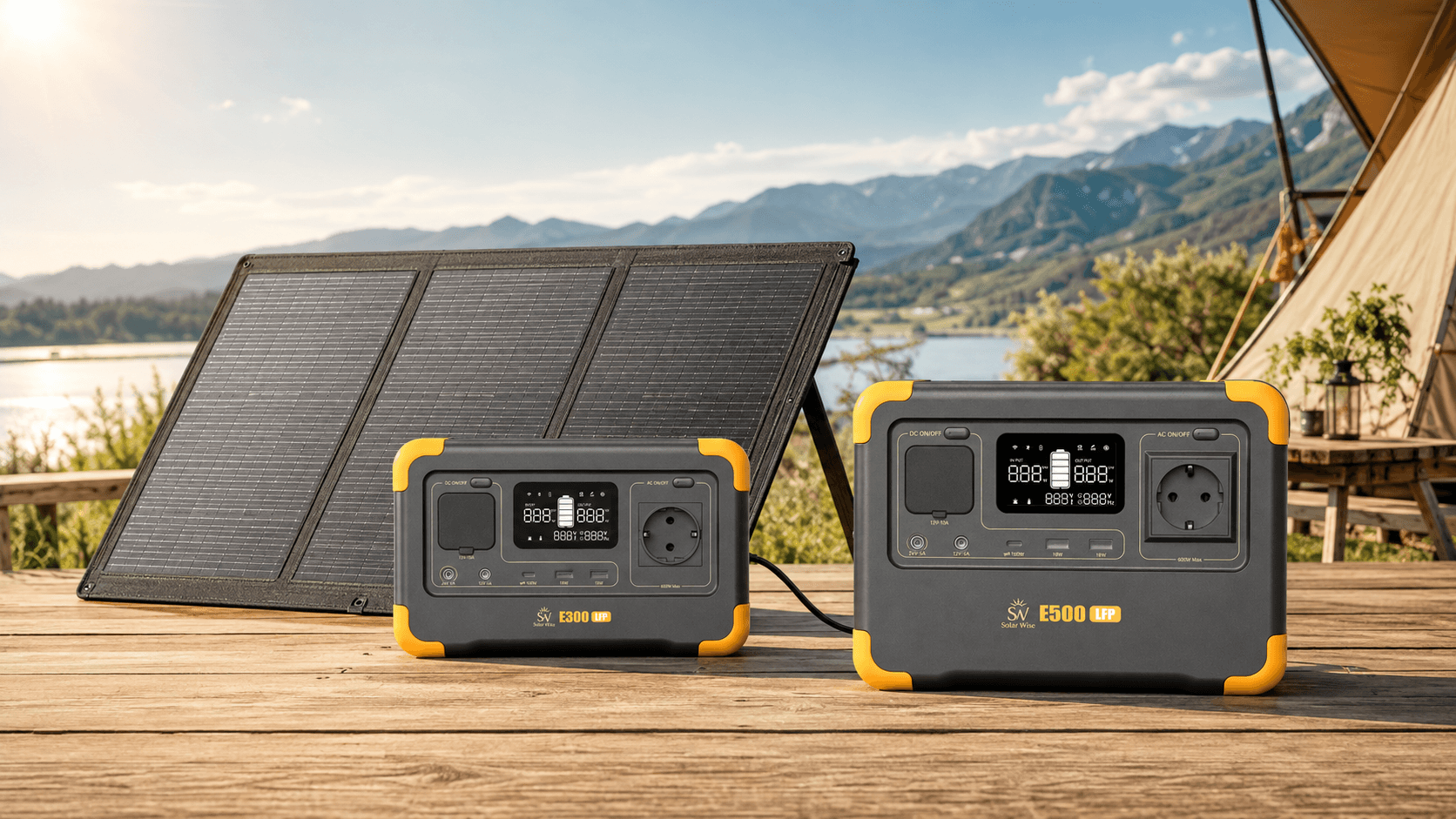
When a power station's battery runs out and there is no grid, the only way to recharge it is a solar panel. The Solar Wise S100 panel has a nominal rating of 100W and connects directly to the solar input of the E300LFP and E500LFP using the supplied DC5521 cable; no adapter or converter is needed.
This changes the picture entirely for outages that can last several days: the panel refills the battery during the day, and the power station supplies the house at night. For setup and timing details see how to charge a power station with a solar panel.
Which Model Should You Choose?
The choice depends on how many devices you want to run and for how long. Both models offer the same 600W pure sine wave AC output; the difference is battery capacity.
| Your need | Suitable model |
|---|---|
| Modem + one lamp + phone charging, a few hours of outage | E300LFP (288Wh · 4.8 kg) |
| The same devices + a laptop, an overnight or longer outage | E500LFP (576Wh · 6.75 kg) |
| The possibility of outages lasting more than a day | Power station + S100 solar panel |
If you want a closer look at what the 600W class covers, see what a 600W power station can run, and for an assessment focused on home use see is a portable power station suitable for home. All models are on the Solar Wise shop page.
Frequently Asked Questions
Will my modem work during a power outage?
Not on its own, because it is powered from the grid. Connected to a power station, official figures give up to 20 hours with the E300LFP and up to 40 hours with the E500LFP. If it is connected in UPS mode, the switchover happens without the connection dropping.
Can a power station supply the whole house?
No. Solar Wise models provide 600W of continuous output, which is not enough to supply a home's entire installation. Connection to the fixed installation is also only possible through a licensed electrician and a suitable transfer switch. A power station is designed to run a few plug-in devices of your choosing.
Can I run an electric heater?
No. Electric heaters draw far more than the 600W limit. A power station is not a suitable solution for heating during an outage.
Can I use the power station while it is charging during an outage?
According to the user manual, charging and use at the same time are possible, provided the incoming charge power is higher than the average consumption. During an outage that means recharging from a solar panel while simultaneously running a low-power device such as a modem.
How long does a power station last?
For the LiFePO4 batteries used in Solar Wise models, the manufacturer publishes a figure of more than 80% remaining capacity after 3,500 charge cycles. There is no fuel, oil or filter maintenance.
Will a combi boiler work?
In Türkiye, combi boilers are sometimes installed with a plug and sometimes wired directly into the fixed installation, and their electronic boards can be sensitive to the supply source. For that reason a general "yes it works" answer would be wrong; you need to check how your own boiler is connected and what its manufacturer says.
Conclusion
What keeps running at home during a power outage depends on the output power and the battery capacity of the device you have. A 600W-class portable power station will run a modem, lighting, a laptop, phones and similar low-power devices for hours — but it is not enough for high-power appliances such as an electric heater, an air conditioner or a water heater.
The best preparation is to decide before the outage which devices you will run, and to note their wattage once. The rest is simple arithmetic.
Comments
Be the first to comment
Log in to leave a comment.
Log InNo comments yet. Be the first to comment!