What Are Watts and Watt-Hours (Wh)? Key Differences for Choosing a Power Station
What is Wh, what is a watt, and what is the difference between them? Watts describe power, while watt-hours indicate the amount of energy stored in a battery. Learn how to evaluate both when choosing a portable power station.
Solar Wise Energy Team
Portable Energy Specialists
- Watt (W): A unit of power.
- Watt-hour (Wh): A unit of energy.
What Is the Difference Between Watts and Watt-Hours?
Two of the most common technical values you will see when comparing portable power stations, batteries, and electronic devices are watts (W) and watt-hours (Wh).
Although these two terms are related, they do not describe the same thing.
In simple terms:
This distinction is especially important when choosing a portable power station.
When asking “Which devices can I run?”, the wattage is one of the main values to consider. When asking “How long can I run them?”, battery capacity in Wh and the actual power consumption of the connected device must be evaluated together.
What Is Wh?
Wh stands for watt-hour. It is a unit used to describe an amount of electrical energy.
In simple terms, 1 Wh represents the amount of energy used when 1 watt of power is consumed for 1 hour.
The basic relationship is:
Wh = Watts × Hours
For example, if a device continuously consumes 100W for 2 hours, the theoretical energy consumption is:
100W × 2 hours = 200Wh
In portable power stations, the Wh rating is one of the main values used to indicate how much energy is stored in the battery.
For example:
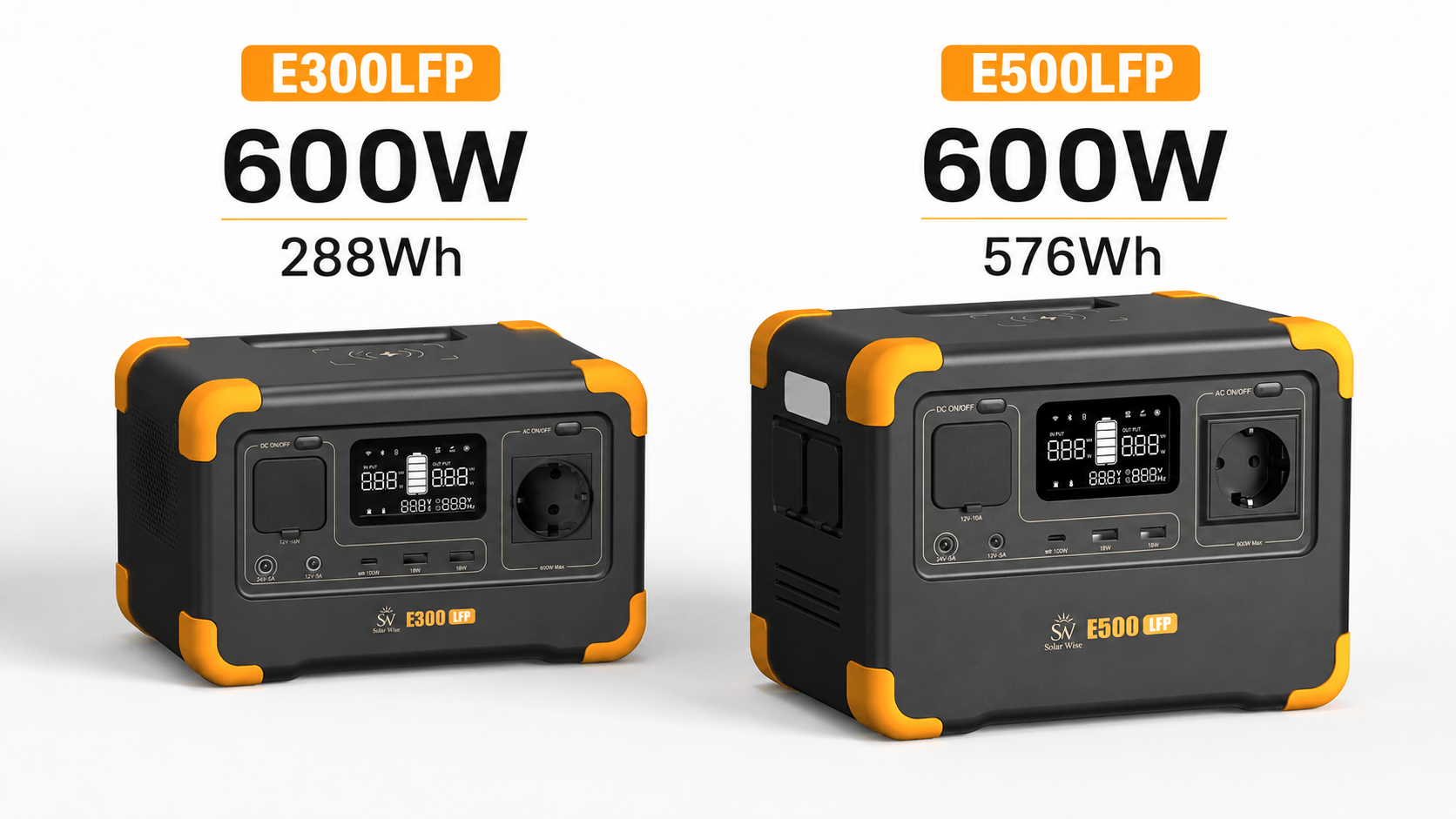
- Solar Wise E300LFP: 288Wh
- Solar Wise E500LFP: 576Wh
The E500LFP has a higher Wh rating, which means it stores more energy than the E300LFP.
What Is a Watt?
A watt (W) is a unit of power.
For a portable power station, the watt rating helps determine whether the power requirements of connected devices are within the supported output limits.
Both the Solar Wise E300LFP and E500LFP provide:
600W continuous pure sine wave AC output.
This means that although their battery capacities are different, both models belong to the same continuous AC output class.
Before connecting a device, you should check its actual wattage.
Devices containing motors, pumps, or compressors may also require higher power for a short period when starting than during normal operation.
What Is the Main Difference Between Watts and Wh?
The simplest way to understand the difference is:
- Watts = Power
- Wh = Amount of energy
For a portable power station:
- Watts: Help determine whether the station can support the power requirement of a device.
- Wh: Indicate how much energy is stored in the battery and are one of the main factors affecting runtime.
The Solar Wise models provide a clear example:
- E300LFP: 600W output / 288Wh capacity
- E500LFP: 600W output / 576Wh capacity
Both models provide the same continuous AC output power, while the E500LFP stores more energy.
Are 600W and 600Wh the Same Thing?
No.
600W and 600Wh cannot be used interchangeably.
600W is a power rating.
600Wh is an energy capacity rating.
For example, the Solar Wise E300LFP has:
- AC output power: 600W
- Battery capacity: 288Wh
This example clearly shows why watts and watt-hours describe different characteristics.
How Is Wh Calculated?
The basic formula for calculating energy from power and time is:
Wh = W × hours
For example, if a device continuously consumes 50W for 4 hours:
50W × 4 hours = 200Wh
In the opposite direction, a theoretical runtime can be estimated by comparing battery capacity with device power consumption:
Theoretical runtime = Wh ÷ W
However, this is only a theoretical calculation.
Actual runtime can be affected by factors such as conversion losses, changing device power consumption, temperature, operating conditions, and other devices connected at the same time.
How Do I Know Which Devices a Power Station Can Run?
First, check the wattage of the device you want to use.
This information can usually be found on:
- The technical label on the device
- The power adapter
- The user manual
- The manufacturer's technical specifications
Then compare the device's power requirement with the continuous output capability of the portable power station.
If multiple devices will be used at the same time, their combined power consumption must be considered.
How Do I Know How Long a Device Will Run?
To evaluate runtime, you need two main values:
- The battery capacity of the power station in Wh
- The actual power consumption of the connected device in W
A higher Wh rating means that more energy is stored in the battery.
However, actual runtime does not depend on Wh alone.
It can also be affected by:
- Energy conversion losses
- Variable power consumption
- Ambient temperature
- Other devices connected at the same time
- The operating pattern of the device
For devices such as refrigerators, where the compressor does not run continuously, it is not accurate to calculate an exact runtime using only the wattage shown on the label.
Why Are E300LFP and E500LFP Different If Both Are 600W?
Because wattage describes only the output power. Battery capacity is a separate specification.
- 600W continuous pure sine wave AC output
- 288Wh LiFePO4 battery capacity
- 600W continuous pure sine wave AC output
- 576Wh LiFePO4 battery capacity
Both models therefore belong to the same continuous AC output class, but the E500LFP stores more energy.
This difference becomes especially important when longer operating time is required.
Does Higher Wattage Mean Longer Runtime?
No.
A higher watt rating does not automatically mean longer battery runtime.
Watts describe output power, while Wh describes stored energy.
Two power stations can therefore have the same watt rating but different Wh capacities and provide different runtimes with the same connected device.
Does a Higher Wh Rating Mean It Can Run Any Device?
No.
A higher Wh rating means that more energy can be stored in the battery, but it does not by itself determine whether a device can be powered.
If the device requires more power than the power station's supported output, a high battery capacity alone does not make the device compatible.
Therefore:
- Use watts to evaluate device power compatibility.
- Use Wh to evaluate stored energy and runtime.
Both values should be considered together.
What Happens When Multiple Devices Are Used at the Same Time?
When several devices are used simultaneously, their combined wattage must be considered.
At the same time, total energy consumption increases, so the battery will discharge more quickly.
For example, operating only a modem will not provide the same runtime as operating a modem, laptop, and lighting at the same time.
Both total power requirement and total energy consumption should therefore be evaluated.
When Choosing a Portable Power Station, Is Wattage or Wh More Important?
Neither value is more important on its own.
You need both to choose the right portable power station.
1. Which devices do I want to run?
The answer helps determine the required output power in watts.
2. How long do I want to run those devices?
The answer helps determine the required battery capacity in Wh.
A suitable power station should satisfy both requirements rather than being selected based only on one specification.
Quick Summary: Watts vs Wh
- Watt (W): Measures power.
- Wh (watt-hour): Measures an amount of energy.
- Which devices can it run? → Check the watt rating.
- How long can it run them? → Evaluate Wh capacity together with device consumption.
- Do two power stations with the same wattage provide the same runtime? → Not necessarily. Different Wh capacities can result in different runtimes.
Frequently Asked Questions
What does Wh mean?
Wh stands for watt-hour. It is a unit of energy and is commonly used to describe how much energy is stored in a battery.
What does 1 Wh mean?
1 Wh represents the amount of energy used when 1 watt of power is consumed for 1 hour.
What is the difference between watts and Wh?
Watts measure power, while Wh measures energy. In a portable power station, watts describe output capability, while Wh indicates battery energy capacity.
Are 600W and 600Wh the same?
No. 600W is a power rating, while 600Wh is an energy capacity rating.
Does a higher Wh rating provide longer runtime?
Under similar conditions and with the same connected device, a higher Wh capacity means more stored energy. Actual runtime can still be affected by device consumption, conversion losses, temperature, and other operating conditions.
What Does 288Wh Mean?
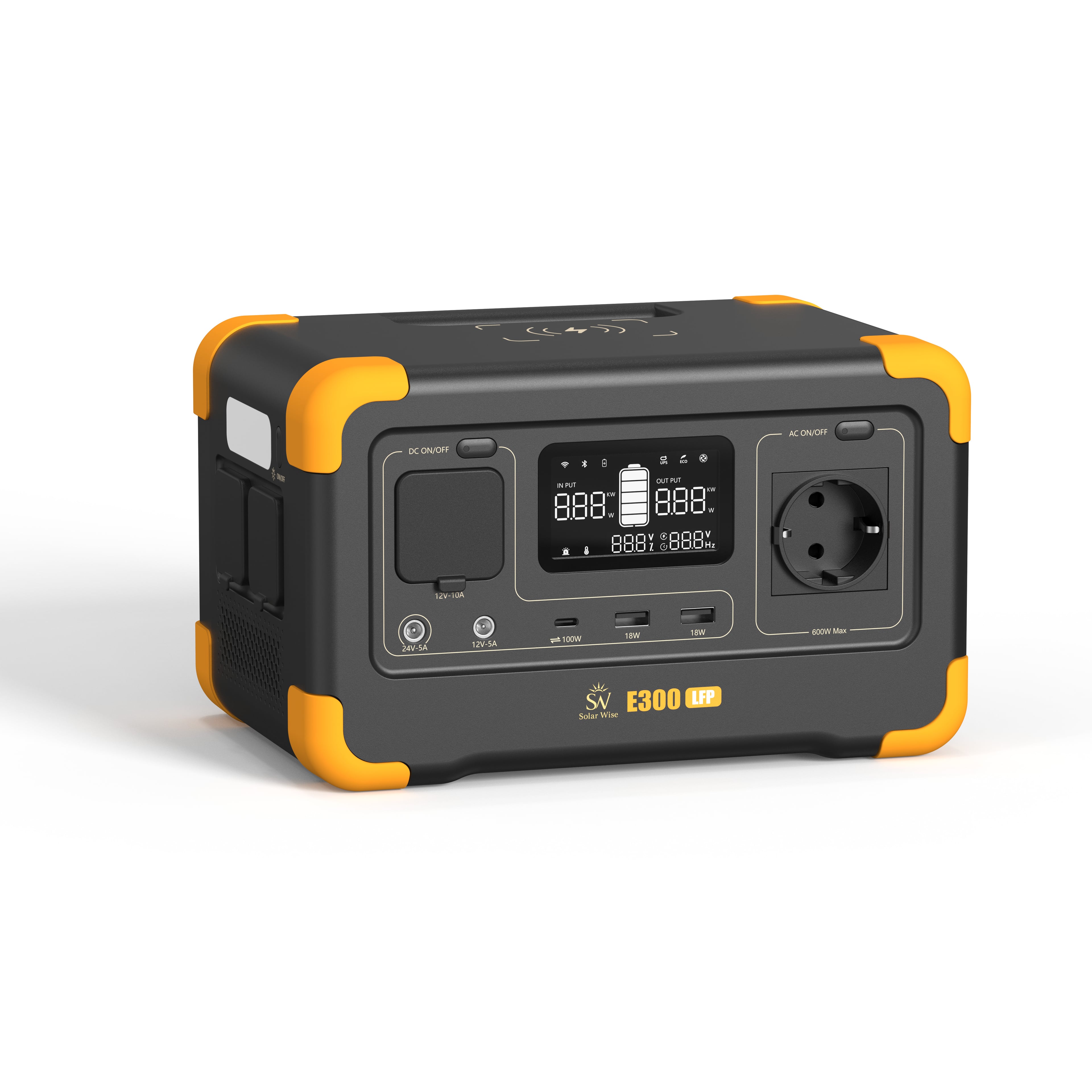
288Wh means a battery can store 288 watt-hours of energy — enough to run a 288-watt device for about one hour, or a lower-power device for longer. The Solar Wise E300LFP portable power station has a 288Wh LiFePO4 battery, making it a common real-world reference point for what 288Wh actually looks like in daily use.
What Does 240Wh Mean?
240Wh means a battery can store 240 watt-hours of energy, roughly enough to power a 240-watt device for one hour or a 24-watt device for about 10 hours. That is a smaller capacity than the Solar Wise E300LFP's 288Wh battery, though the exact runtime always depends on the connected device's actual power draw.
What Does 300Wh Mean?
300Wh means a battery stores approximately 300 watt-hours of energy. It is often used as a rounded figure — for example, the Solar Wise E300LFP is sometimes searched as a "300Wh" power station, though its exact rated capacity is 288Wh. Always check a product's precise Wh rating in its specifications rather than relying on a rounded model name.
Is Wh the Same as Watts?
No. A watt (W) measures power — how fast energy is used or delivered at a given moment. A watt-hour (Wh) measures energy — the total amount used or stored over time. A portable power station's watt rating tells you which devices it can run, while its Wh rating tells you how long it can run them.
Conclusion
Watts and watt-hours are both important when choosing a portable power station, but they describe completely different characteristics.
Watts describe output power, while Wh describes the amount of energy stored in the battery.
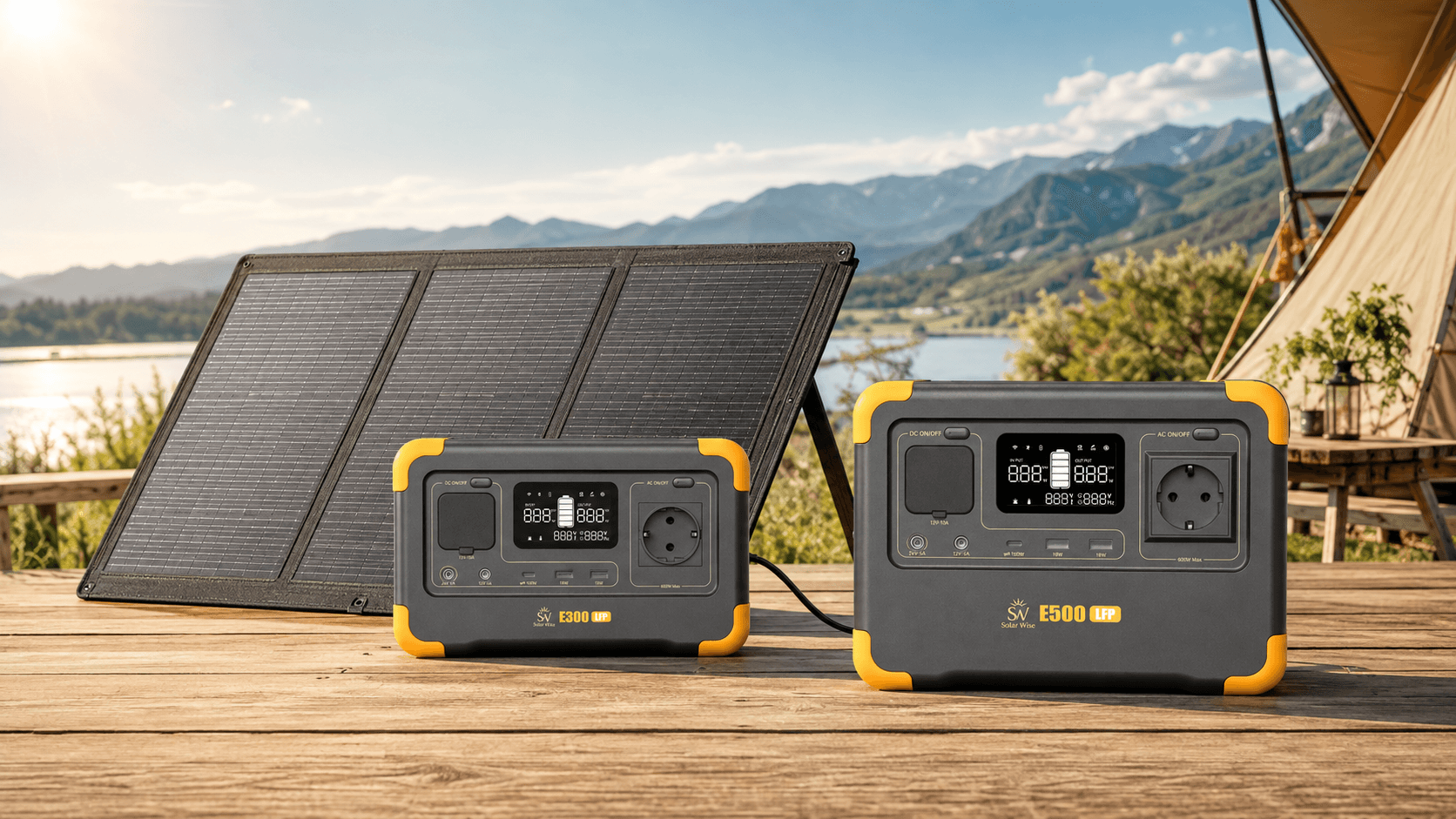
Both the Solar Wise E300LFP and E500LFP provide 600W continuous pure sine wave AC output:
The right choice depends both on the power requirements of the devices you want to use and the amount of stored energy you need for your expected runtime.

Comments
Be the first to comment
Log in to leave a comment.
Log InNo comments yet. Be the first to comment!